
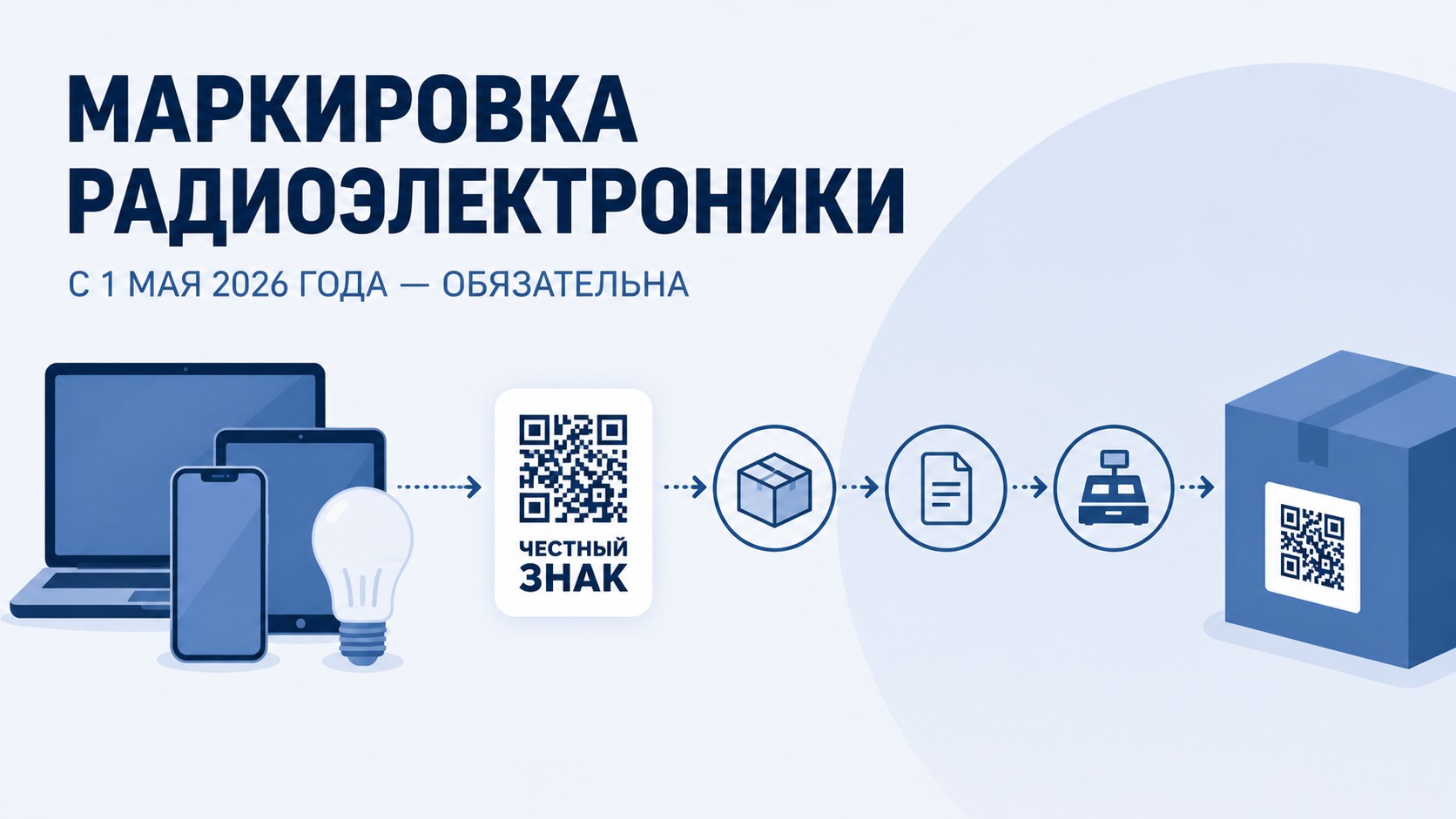
 Starting May 1, 2026, mandatory labeling of certain types of radio-electronic products comes into force in Russia. The new rules were approved by Decree of the Government of the Russian Federation No. 1954 of November 28, 2025, and represent another major step in expanding the state system for digital traceability of goods.
If a few years ago labeling was seen as an experiment for footwear, tobacco, and clothing, now the electronics market — one of the largest trade segments — is gradually coming under state control.
For businesses, this means not just the appearance of new stickers on products, but a fundamental restructuring of several processes: from imports and warehouse accounting to cash registers, EDI, and working with marketplaces.
What exactly is subject to labeling
Radio-electronic products included in the lists of HS codes of the EAEU and OKPD2, approved by Government Decree No. 1954, are subject to labeling.
The list includes, in particular:
-
smartphones;
-
mobile phones;
-
laptops;
-
tablets;
-
certain types of lighting products;
-
some electronic devices and components.
It is important to understand: labeling is not being introduced for all electronics without exception, but only for products directly specified in the decree.
The operator of the state labeling system is the Center for the Development of Advanced Technologies (CRPT), and the work is carried out through the “Honest Sign” system.
How the implementation will take place
The transition to the new rules is divided into several stages.
From May 1, 2026
Manufacturers and importers are required to apply labeling codes to products placed into circulation.
Until May 31, 2026
Import of unlabeled products is permitted provided they are subsequently labeled after import.
Until November 30, 2026
Sales of remaining unlabeled goods previously placed into circulation are allowed.
From December 1, 2026
Mandatory per-unit product accounting through electronic document interchange (EDI) is introduced. The movement of each unit of goods must be reflected in the system.
From March 1, 2027
The disposal of labeled products through cash register equipment (CRE) becomes mandatory. Selling a product without transmitting disposal information via CRE will be considered a violation of the rules for handling labeled products.
Who will be affected by the new rules
Although the obligation to apply labeling rests primarily on manufacturers and importers, the changes will actually affect the entire product circulation chain:
-
wholesale companies;
-
distributors;
-
marketplaces;
-
online stores;
-
retail trade;
-
warehouse complexes;
-
service companies working with accounting and logistics.
For many companies, this means the need to modernize their accounting systems and revise internal processes.
What will change for businesses
Labeling of electronics is no longer just a trade issue. It is an issue of IT infrastructure, accounting, and digital document flow.
Businesses will need to:
-
register in the “Honest Sign” system;
-
organize work with EDI;
-
ensure compatibility of cash registers and accounting systems;
-
configure integration of 1C and warehouse accounting;
-
organize work with labeling codes;
-
train staff.
The transition may be particularly difficult for companies working with parallel imports, mixed batches of goods, and marketplaces.
A separate problem is product balances. Businesses need to understand in advance which goods can be sold without labeling and which will need to be entered into the system.
Why the state is strengthening control
The official goal of the reform is to combat counterfeiting, gray imports, and illegal turnover of equipment.
However, in practice, the state continues to expand the system of digital traceability of goods. Gradually, the following are being integrated:
-
cash register equipment;
-
electronic document interchange;
-
labeling;
-
tax control;
-
information on the movement of goods.
In fact, a unified digital model for controlling goods turnover is being formed — from the import of products into the country to the sale to the end customer.
What risks arise for businesses
Entrepreneurs are already facing problems when implementing labeling in other product groups:
-
increased accounting costs;
-
need to upgrade equipment;
-
errors in integration with EDI;
-
failures in code transmission;
-
difficulties with returns;
-
additional burden on employees.
For small businesses, the costs of automation and maintenance of the labeling system become a particular problem.
At the same time, liability for violations remains quite serious.
The legislation provides for administrative liability for the circulation of unlabeled products, including fines and, in some cases, confiscation of goods. Certain violations can also lead to the actual impossibility of selling products through cash register equipment.
What needs to be done right now
Experts recommend that businesses not delay preparing for the new requirements.
Right now, it is advisable to:
-
check whether the product is subject to labeling;
-
analyze remaining stock;
-
assess the readiness of 1C and cash register equipment;
-
connect EDI;
-
test work with the “Honest Sign” system;
-
determine the procedure for labeling imported products;
-
train staff to work with the new system.
The year 2026 continues to show that accounting, automation, and digital control are becoming not just an additional function for businesses, but a necessary condition for working in the market. And the labeling of radio-electronic products is further confirmation that state requirements for the transparency of goods turnover will only increase.
Source: https://buh-a.ru/o-companii/novosti/11-novosti/378-s-2026-goda-elektroniku-postavyat-pod-tsifrovoj-k
Telegram: auditoriya_buh
MAX: https://max.ru/id7716236377_biz
E-mail: auditoriya@buh-a.ru