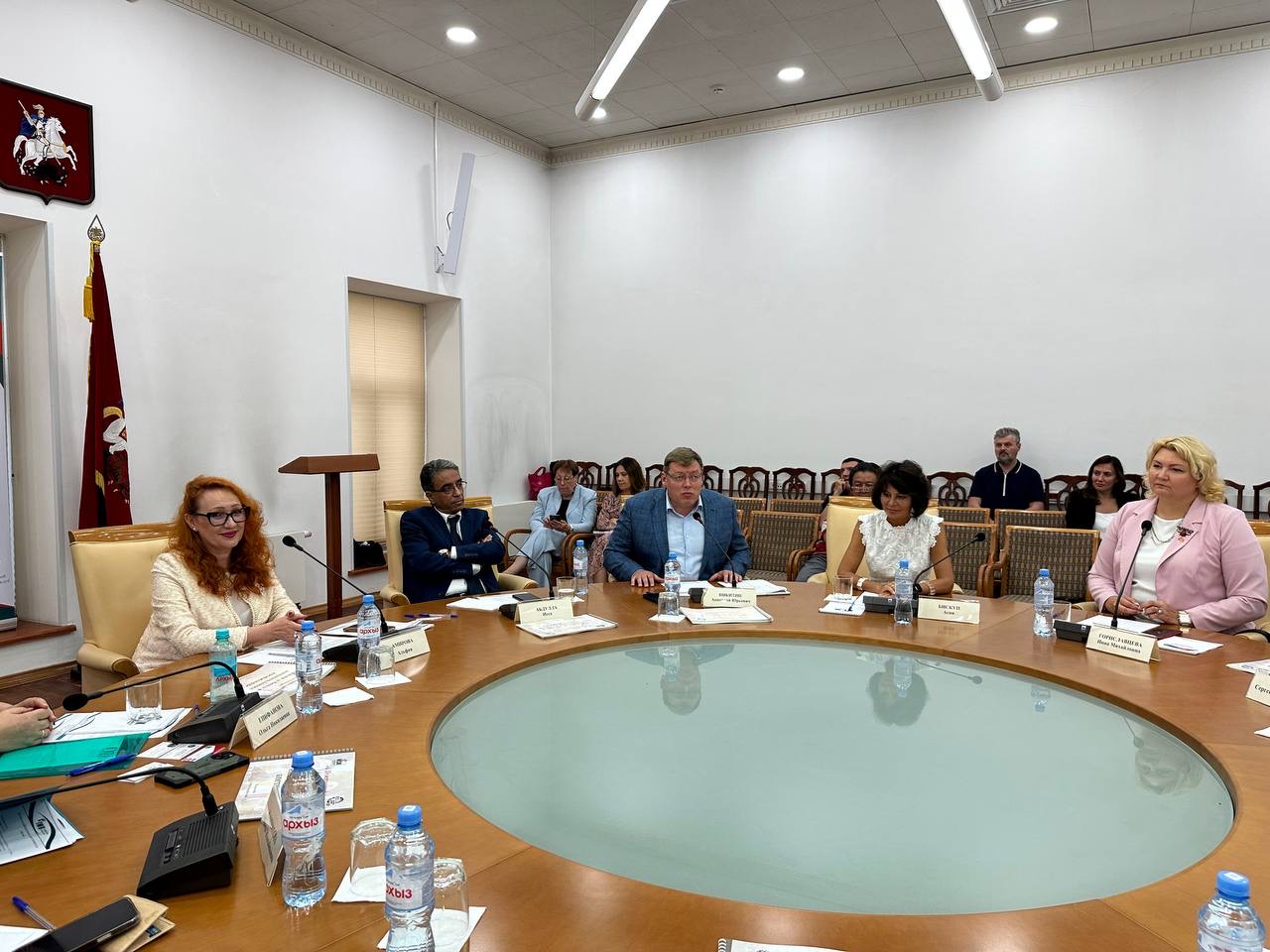
 On July 26, 2023, a meeting of the International Discussion Club “VISION 3000” was held with the support of the Moscow Government (Department of National Policy and Interregional Relations of the City of Moscow, GBU “Moscow House of Nationalities”) in the Moscow House of Nationalities.
The agenda of the meeting was devoted to the topic “Cultural dialogue. Interethnic relations”.
The speaker was Anatoly Nikitin, a deputy of the Moscow Regional Duma. Deputy Chairman of the Committee on Budget, Financial, Economic Policy, Investment and Entrepreneurship.
The topic of the speech is “Socio-economic development is the key to interethnic harmony, and interethnic harmony is the source of investment attractiveness of Russian regions.”

Good afternoon, dear colleagues! We are gathered here for a very important, timely and frank conversation. The topic of interethnic relations in our country sounds like one of the key vectors of Russia’s development. And this is completely objective for a state in which 190 nationalities live, for a territory where almost 10 percent of the population are migrants from neighboring countries. In the light of recent geopolitical events, it has escalated even more.
I would like to discuss this issue, first of all, as an industrialist, as the head of a large manufacturing enterprise, the president of the Association of Russian Miners.
And the first thing any manager will say in my place is the aggravation of the situation on the labor market. Today, Russia is experiencing the most massive personnel shortage since 1996. There are many reasons – aging of the population, natural decline, migration processes within the country, demographic pit. Therefore, if we evaluate it from a purely economic point of view, today Russia simply needs attracted labor from other countries.
It is estimated in millions of people. These are specialists who are engaged in construction, agriculture, mining enterprises, trade, services and housing and communal services. The average salary for representatives of other countries who come to Russia is about 50 thousand rubles. This is higher than the average monthly earnings in most regions.
Moreover, from an economic point of view, this process is mutual – the economy of the countries from which they come to us depends to a very large extent on revenues from Russia. Almost two–thirds of Tajikistan’s GDP are transfers from those working in Russia.
The economic factor in this matter is certainly decisive. Without any philosophy – people are looking for where it is better, where it is more realistic to provide for their family.
But also politically, Russia does a lot so that those who come from other countries and friendly states do not feel like strangers. In recent years, there have been active integration processes in the Eurasian space. Today, the Eurasian Economic Union has been formed and is strengthening, which helps international businesses to interact more actively. A lot is being done for those who come to Russia to work – clear conditions for entry and official registration, a simplified procedure for obtaining a patent. Russia is open to anyone who is willing to consider it a permanent place of residence. Visitors are entitled to all family payments, child birth benefits, and a pension.
Where are the flaws? – in the official registration of employment in the country, in the regular deduction of taxes. Violations are being recorded less and less here, but still they should be minimized. Because, I repeat, the conditions for open activity in Russia are now created for everyone. And another important point is that the economy is being transformed today, the qualitative aspect is replacing the principle of “take volumes”. High technologies are being developed, production facilities are being modernized. This means that those who see themselves as a specialist within these processes face a challenge to improve their qualifications, study, and integrate even deeper into economic and social processes within Russia.
The second important aspect of my topic is interethnic harmony within the country. And in this regard, I would like to recall the very precise words of our President Vladimir Putin at the last meeting of the Council on Interethnic Relations:
“Our ancestors worked together from generation to generation for the benefit of their native, common, great Motherland, multiplying the spiritual heritage of a single state with the diversity of their languages and traditions, forming its unique multinational multi-confessional culture. Multinational harmony is the most important foundation of our consolidation, which is only getting stronger in the face of external aggression and threats.”
His words are also confirmed by figures. If in 2017 the level of civil identity – there is such an indicator in sociology – was estimated at 63 percent, then last year it rose to 94 percent. Yes, now our country, regardless of customs, languages and nationalities, has united again for the sake of fighting an external threat – Nazism. As in 1941, Russians, Kazakhs, Buryats, Kirghiz, Mordvins and – all–all, stood up in a single formation to destroy the global threat. Each of them is ready to sacrifice his life for the sake of the country. The same trend is observed here, in the rear, where everything is also being done for the sake of a common victory.
And first of all, in economic terms. Despite any sanctions, threats and external pressure, we were able to maintain the level of the economy, and to increase it in a number of industries. A number of enterprises have received a new lease of life due to orders for the military-industrial complex. We are getting on the rails of import substitution more and more actively. Now, more than ever, Russia has the opportunity to switch to self-sufficiency. Both an opportunity and a necessity. In particular, serious changes are needed in such industries as machine-tool and shipbuilding, mechanical engineering, textile production.
Yes, it should be a serious revision of the policy on the part of the state – new support measures, popular preferential programs, leasing and subsidies. Then everyone will have a stable job, the number of people who survive on the minimum wage will decrease, and the general welfare of citizens will increase. Then investments will be not only in production, but also in society, improving living standards.
From a social point of view, interethnic unity can and should be a guarantee of change, as a guarantee of peace and stability of the regions.
Today, Russia has a Strategy of state national policy. The latest amendments to the Constitution have consolidated the culture of identity of all the peoples of Russia, its interethnic diversity. The monitoring system has been strengthened in order not to eliminate, but to warn at the stage of the emergence of points of interethnic tension. And judging by today’s dialogue, the sense of cohesion between us is only getting stronger over the years.
Dear colleagues, I want to thank everyone for an open, honest conversation and add that we have once again proved that Russia is a country where everyone is their own, and are ready to help each other, regardless of the difference in languages and cultures.